
Daily English Speaking Practice Sentences for Beginners: The Real Starter Guide
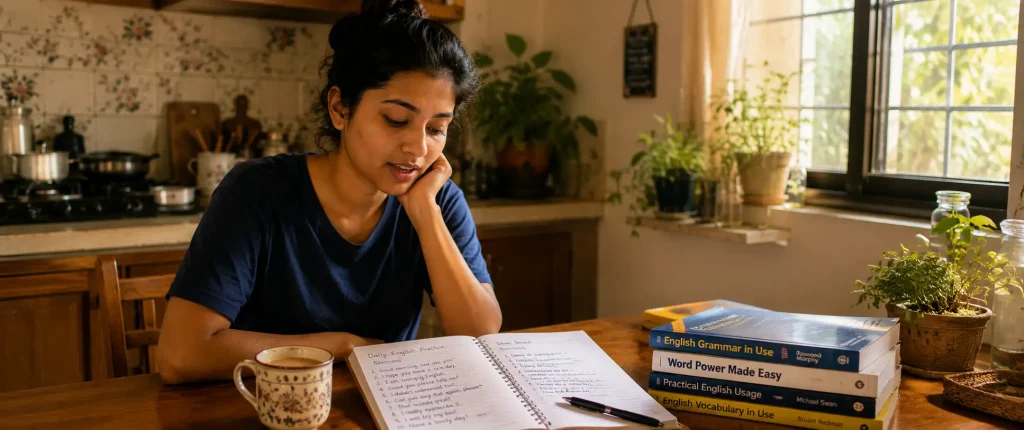
Alright, quick question. You have been studying English for a while now. Quite a few words are already in your vocabulary. The grammar exercises are done too. But the moment someone actually speaks to you in English, your mind goes blank. That is exactly why daily English speaking practice sentences matter more than any grammar book ever will.
This is not a language problem at all. Lack of practice is the real issue here.
Nobody gets fluent by reading about English. You get fluent by saying things out loud, getting it slightly wrong, adjusting and trying again. The people who speak English well are not the ones who studied the hardest. They are the ones who spoke the most, even badly, even nervously, even with a thick accent.
So that is what this guide is for. Real daily English speaking practice sentences that you can use today. Not in six months once your grammar is sorted. Today.
Why Your Daily English Speaking Practice Sentences Matter More Than Grammar
Grammar is useful. Nobody is arguing against that. But there is a problem with learning grammar before you learn to speak. You end up thinking in your native language and then translating every sentence in your head before you say it. That takes too long. Conversations do not wait.
What actually works is learning chunks. Phrases. Full sentences that you have said so many times they just come out automatically. When someone asks “How are you?” you do not want to think about verb conjugation. You want “I’m doing well, thanks — how about you?” to just appear in your mouth.
That is what English speaking practice sentences for beginners actually do. They bypass the translation step entirely. And that is why they work faster than grammar drills ever will.
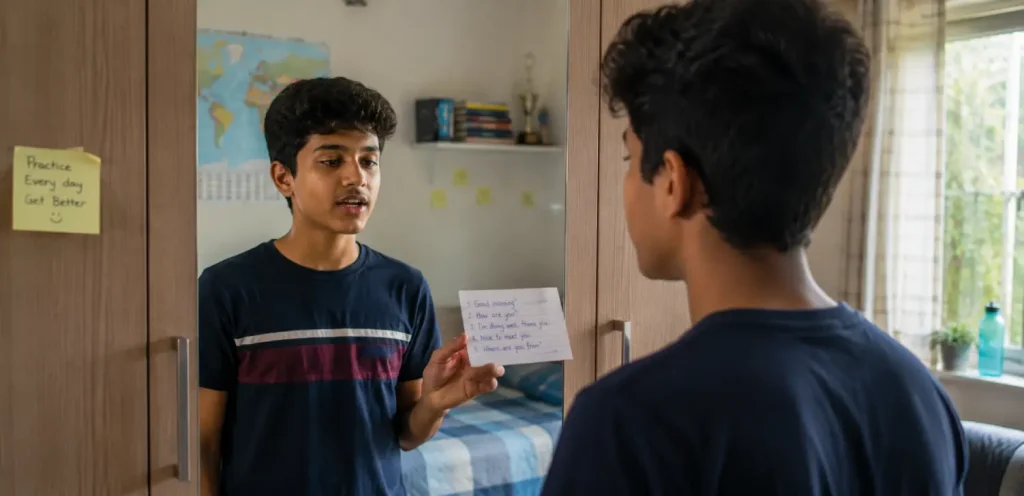
One thing worth saying here: the sentences in this guide are written in everyday British English. Some of the phrasing will sound slightly different from American English. “How do you do” instead of “What’s up.” “Cheers” instead of “Thanks a lot.” Neither is wrong. But if you are aiming for British-style English, this guide speaks your language.
Greetings and Introductions: Where Daily English Sentences for Speaking Practice Begin
Most learners underestimate how far a good greeting gets them. When your hello sounds natural, the other person immediately relaxes. The whole conversation starts from a better place. So these are the sentences worth getting very comfortable with first.
For meeting someone new:
- “Hello! Lovely to meet you. I’m [Name].”
- “Hi there — I don’t think we’ve met. I’m [Name].”
- “Good morning. How are you keeping?”
- “Nice to meet you. Where are you from originally?”
- “I’m still finding my feet with English, so bear with me.”
For people you already know:
- “Morning! Good weekend?”
- “Alright? How’s things been?”
- “Haven’t seen you in ages — how’ve you been?”
- “Good to see you. Everything going well?”
That last phrase in the first list — “I’m still finding my feet with English, so bear with me” — is genuinely one of the most useful everyday English speaking sentences a beginner can have. Say it early. People immediately become more patient. They slow down, they speak more clearly, and they stop worrying about your grammar. It takes the pressure off both of you.
For more structured speaking exercises built around introductions and greetings, Cols Calibre’s spoken English resources have practical, real-world conversation practice for beginners.
Polite Requests: The Simple English Speaking Sentences That Get Things Done
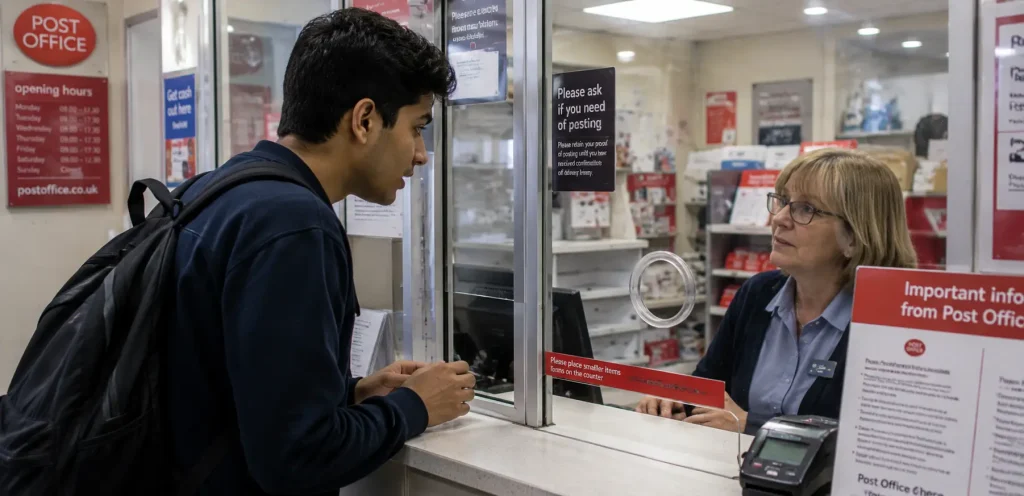
There is a reason politeness gets emphasised so much in English. It is not just manners. In British English especially, a polite request sounds completely different from an impolite one, even if the words are almost the same. “Give me that” and “Could I possibly have that, please?” technically ask for the same thing. One gets a warm response. The other gets a cold one.
These spoken English practice sentences cover the polite phrasing that native British speakers actually use:
- “Hi there, can I get some help please?”
- “Would you mind saying that again a bit more slowly?”
- “I’m sorry, I didn’t quite follow — could you repeat that?”
- “Is it alright if I ask you a quick question?”
- “Could I possibly borrow a pen? I’ll give it straight back.”
- “Sorry to stop you — do you know how to get to [place]?”
- “Can I sit here, please?”
British people use “Would you mind…” very often in their day to day conversations. Get comfortable with it. Once you can slot any request into that structure, you will handle most polite situations without thinking too hard.
A Handy Reference Table: English Conversation Practice Sentences for Everyday Situations
Keep this table somewhere useful. Saving a photo of it on your phone is just as handy. The goal is to have at least one solid sentence ready for each of these situations before you find yourself in them.
| Situation | English Practice Sentence | A Note |
|---|---|---|
| First introduction | “Lovely to meet you. I’m [Name].” | Add a detail — your city, your work |
| Didn’t understand | “Sorry, I didn’t catch that — could you say it again?” | Use this freely. It’s completely normal |
| Asking the time | “Do you have the time please?” | Add “by any chance” for softer tone |
| Ordering at a café | “Could I get a flat white, please? And a receipt if possible.” | “Could I get” is very natural here |
| Shopping query | “How much is this one?” / “Do you have this in a medium?” | Keep it short and direct |
| Asking directions | “Do you know the way to [place] please?” | Follow up: “Is it far on foot?” |
| When you’re confused | “I’m not quite sure I understood — would you mind explaining?” | Honest and polite |
| Ending a conversation | “It’s been great talking to you. Have a lovely day.” | Very natural British closing |
| On a phone call | “Hello, this is [Name] speaking. Could I speak to [Person]?” | Formal but not stiff |
| Saying thanks | “Cheers, I really appreciate that.” | Casual. Use with people your age. |
Daily Use English Sentences for Talking About Your Own Day
This is a practice technique that sounds too simple to work. It isn’t. Narrating your own routine in English — even just in your head, even better out loud — is one of the fastest ways to make daily English sentences for speaking practice feel completely natural.
The reason it works is repetition through real life. You make tea every morning. So you say “I usually put the kettle on first thing.” You do that a hundred mornings and it becomes permanent. Your brain has connected the English sentence to the actual experience, not just to a textbook memory.
Morning sentences to practise:
- “I’m up at about half six most mornings.”
- “First thing I do is make a brew and have a sit-down.”
- “I try to leave before the rush if I can manage it.”
- “I usually have something quick for breakfast — toast or cereal.”
During the day:
- “I had a fairly hectic morning, to be honest.”
- “I grabbed a sandwich at lunch and ate at my desk.”
- “I’ve got a meeting this afternoon I need to prepare for.”
In the evening:
- “I got in around seven. It was a long one.”
- “I had dinner, did the washing up and just needed to sit down.”
- “I usually try to read a bit before bed if I’m not too tired.”
Notice the British English rhythm in those. “Make a brew.” “Had a sit-down.” “Got in around seven.” These are the daily spoken English sentences that will make you sound natural rather than textbook-translated.
If you want a structured plan that turns this kind of narration into a proper weekly habit, Cols Calibre’s daily English practice guides are worth a look.
English Speaking Sentences for Beginners: Shopping in Britain

Shopping in Britain has its own small rituals. “You alright?” at the till is a greeting, not a health check. “That’s lovely, cheers” means thank you. Understanding these small things matters as much as the actual words do.
Here are the English speaking sentences for beginners that cover a real British shopping trip:
Finding things:
- “Excuse me, where would I find [item]?”
- “Do you stock [item] at all, or would I need to go elsewhere?”
- “Is this the only size you’ve got in this?”
At the till:
- “Am I alright to pay by card?”
- “Could I get a bag please? I haven’t got one with me.”
- “Is there a loyalty card I can sign up to?”
- “Sorry, could I get a receipt please?”
If something’s not right:
- “I think the price has rung up wrong — could you check?”
- “I’d like to return this if that’s alright. I’ve got the receipt.”
- “This isn’t quite what I was after, actually.”
The sentences above are how people genuinely speak in British shops. None of them are formal or stiff. Just normal English conversation practice sentences that fit naturally into any everyday situation.
According to BBC Learning English, one of the most effective ways to build spoken fluency is to practise in short, real-world interactions — shopping, ordering food, asking directions. Not classroom simulations. Actual situations.
Getting Around: English Practice Sentences for Daily Conversation About Directions
Getting lost somewhere unfamiliar is genuinely awful. But it is also an excellent English practice moment. You are stressed. Your brain is alert. And whatever sentences you use in that moment will stick with you for a very long time.
Asking for help:
- “Excuse me, sorry to bother you — could you tell me how to get to [place] from here?”
- “I think I’ve gone a bit wrong. Is [place] this way at all?”
- “How far is it to [place] on foot? Is it walkable?”
- “Which platform is it for [destination], do you know?”
When you don’t follow the answer:
- “Sorry, would you mind saying that again? I got a bit lost.”
- “So it’s left at the lights and then straight on — have I got that right?”
- “Is there a chance you could point the direction?”

The key phrase here is “Have I got that right?” after someone explains the way. It shows you were listening. It gives the other person a chance to correct any misunderstanding. And it buys you a few extra seconds to process the information. That one small sentence saves an enormous amount of confusion.
What Gets in the Way of Learning Spoken English Sentences
Most beginners know what they should be doing. The gap is usually not knowledge. It is the stuff that gets in the way.
Waiting to feel confident before speaking. Confidence is the result of speaking, not the condition for it. It does not arrive first and then allow you to speak. It builds up because you spoke, even when you were nervous. That order matters.
Only practising where it feels safe. Talking to yourself in your bedroom is useful. But it has limits. At some point, the anxiety of a real conversation has to be faced. The good news is it shrinks every single time you get through one.
Treating every mistake as a failure. A mistake in a spoken English conversation is just information. It tells you something that did not quite work. Native speakers get things wrong constantly. They use the wrong word, they trail off mid-sentence, they say “erm” twelve times in a row. None of that stops communication.
Skipping the out-loud part. Reading sentences quietly and saying them out loud are nothing alike. Your mouth needs to learn the shapes of English words. Your ears need to hear your own voice saying them. Silent study skips the part that actually builds spoken fluency.
Learning too many sentences at once. Ten sentences you know cold are worth more than a hundred you sort of recognise. Go deep before you go wide.
Frequently Asked Questions
Start small. Order a coffee, ask the time or buy something at a shop. Each short interaction makes the next one a little easier.
Ten to fifteen new sentences per week is plenty. Focus on knowing them well rather than rushing through a big list.
Not at all. Britain has hundreds of accents. Speak clearly, finish your sentences and you will be understood just fine.
Go with whichever suits your life. Aiming for the UK? Stick with British. Working with American clients? Go with American.
Home practice feels safe because you know what comes next. Ask a friend to respond randomly so you get used to real unpredictable conversations.
Last thought. Learning to speak a new language as an adult takes a specific kind of courage. Not the dramatic kind. Just the quiet, daily kind — the willingness to open your mouth when part of you would rather not. That matters more than your vocabulary size, your grammar score or how long you have been studying. Keep going.