
Learn English in 60 days: the plan that actually works
It is two months. No tricks, no excuses. Sixty days to reach a point where you start communicating in English, sending emails in English, and having conversation in English. And we say that you can do it, because you can. Fluently might be too big an ask, but definitely good enough. Again, this is not a motivational speech. It is the basis of the plan that we created – Learn English in 60 Days
Below is the exact breakdown of the process we recommend. We’ve developed this step by step approach and successfully used it ourselves.
What you Learn English in 60 Days :
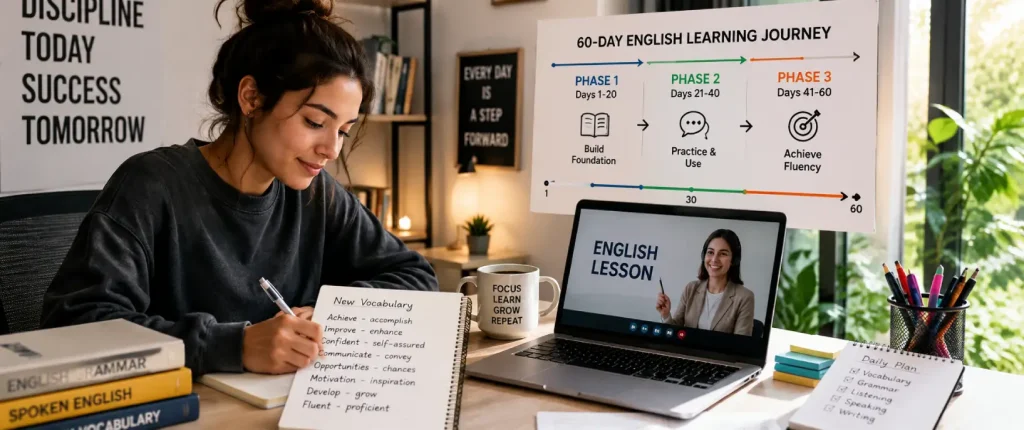
The mistake that forces many people to drop their English practice early is over expectations. Everyone wants to learn English to the point of fluency in two months. While it is impossible, you will be amazed at what you can achieve in two months. You will:
Be able to understand most dialogues
Be able to read and comprehend informal texts such as news articles or WhatsApp conversations in English
Be able to say basic sentences confidently
Be able to write simple understandable texts again, impressive and quite realistic.
How we would divide 60 days into steps:
There are three phases in total, and each lasts 20 days. In each step you will focus on different tasks.
Phase 1: (day 1 to 20) Foundation building
This is the point most students lose interest and stop. Please, do not. What seems boring now will make the difference later. Basic grammar rules and fundamental vocabulary are essential for further development of your language skills. As we always tell our students, foundation building is very slow and frustrating. However, it is the most critical part of this course!
Daily actions:
Learn 10 new words every day. Focus on basics such as human anatomy, food items, numbers and directions.
Practise sentence structures: Subject + Verb + Object (SVO). For example, I eat rice. She reads books.
Watch one short video in English language (up to 10 minutes). For instance, cartoon, YouTube video, etc. Listen attentively to the speakers.
The tip we always give our students here is to write down your words in a notebook rather than learning via applications. It helps much. We’ve met people who were struggling with various apps for months. Writing by hand gives your brain completely different signals, so you should try it for a week ot two. You will see why we say that.
Your goal is to be able to recognize around 200 words after completing this phase. First big success!
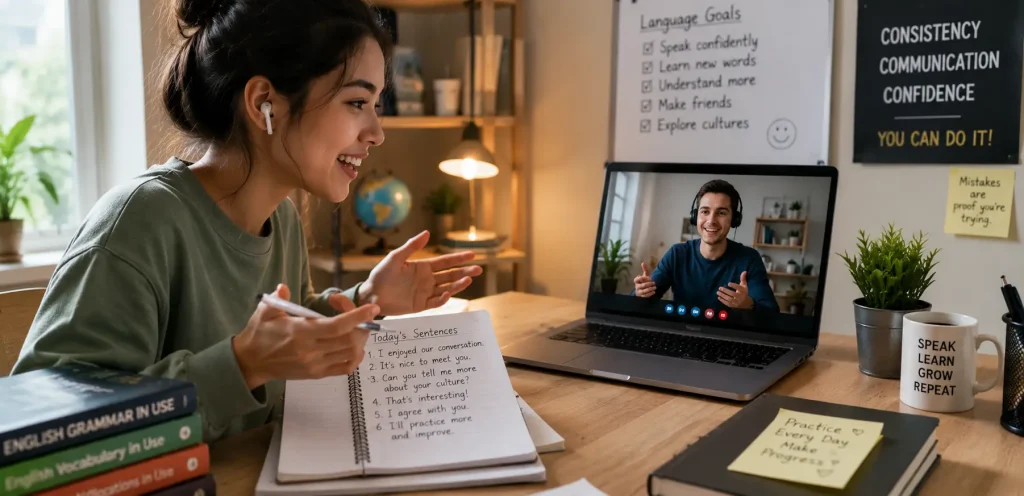
Phase 2: (day 21 to 40) Start using the Knowledge: Learn English in 60 Days
Finally, this is when things get interesting. You’ve accumulated a pool of Knowledge that is to be used now. This step is our personal favorite, as we usually can observe rapid progress among our students.
Action list:
Start speaking out loud (including monologues to yourself), i.e., narrate your actions aloud. For example, “Now I brush my teeth. Next, I make coffee”.
Find a person who knows English, and use language applications such as Tandem and HelloTalk to find language partners.
Read short texts: headlines, blogs in English language, English subtitles on shows you watch.
Add to your daily routine learning 10 new words per day and using each in a sentence.
Moreover, you should consider starting a short English diary now. It is to contain two or three sentences each day. “Today was nice. I spoke with my friend. Together we had pizza”. This practice will train your brain to produce sentences independently. Our experience proves that this habit dramatically accelerates language development. By day 40, you will start thinking in English.
Phase 3: (day 41 to 60) Moving forward to fluent communication – Learn English in 60 Days
Time to abandon training wheels. Now you are expected to apply english rather than lecturing. Real life situation situations await you.
Things to do:
Watch movies/shows in English language. Do not resort to subtitles in your native language. You are watching English, remember?
Conduct at least one full conversation in English daily. Monologue to yourself looking in the mirror is also okay.
Read one short article on the website of BBC Learning English in the morning. All of the materials on that website are absolutely free and perfectly designed for this purpose.
Start writing larger journals (now 5-10 sentences).
This is also the time to pay closer attention to mistakes you make. You must let your language partner correct you and analyse the conversations. Imagine yourself saying those sentences and think of how they could be formulated better. Those who consistently does this improves.
Daily habits that help you follow this plan: Learn English in 60 Days
A piece of advice that we’ve been giving to our students since the beginning. Language learning has nothing to do with how much time spend practicing during weekends. Everything happens when you apply daily.
Daily 30-minute practice beats weekly four hours hands down.
Many people devote themselves totally for two weeks and fail afterwards. But that is not how your brain learns languages. Regular and small inputs, which can be compared to watering plants every day, are better than monthly deluge. Here is how daily routine should look:
Morning: 10 minutes
Revisiting words from yesterday. Learning 10 new words.
Afternoon: 10 minutes
Reading/watching short texts in English language.
Evening: 10 minutes
Writing, speaking and reflecting
for more details check Col’s Calibre
Common mistake that must be avoided:
There are things that will prevent you from progressing faster that usual. We warn you against these mistakes based on our experience.
Waiting until you feel ready to speak. You will never feel ready to do it. Start saying stupid things.
Translating in your head. You cannot avoid it in the initial stages. But it is necessary to move past it. When you see a dog, think about “dog” in English rather than about your native translation of this word and then about dog. Condition your brain.
Focusing exclusively on grammar. Grammar rules matter, there is no doubt about that. However, if you know all the grammar rules by heart, it does not mean that you can order food at a café. Do not forget that language learning involves much more than theory.
Using subtitles in your native language. Of course, it sounds easier. However, in that case, you read your language rather than listen to English. Subtitles in English are to be preferred always.
Faking it. There is nothing wrong with politely asking people to repeat themselves. “Could you please repeat that?” and sorry, I haven’t caught that” are actual expression you use. People don’t think worse of you for using them. They do think worse of you for nodding your head and following through by doing the complete opposite.
Tools for learning:
There are numerous courses and applications out there. These are some of those we found to be actually helpful:
Anki: a free app featuring flashcards based on the technique of spaced repetition, displaying you the vocabulary right before you forgot it;
BBC Learning English – a free website with high-quality content for beginners and advanced students;
Duolingo – a tool for creating a daily routine, not the only one you should consider to succeed with English;
HelloTalk and Tandem – platforms for connecting with native speakers.
English language movies and TV series ideally with english subtitles.
Do you have to study grammar?
The answer would be Yes and No
You don’t have to memorize all of the rules in any English textbook. However, you have to know well enough to create coherent sentences. Over the course of first 60 days, you need to study at least the following:
Present Simple vs Present Continuous (“I eat” vs “I’m eating”);
Past Simple (“I went”, “He said”);
Forming questions (not “Where you are going?”, but “Where are you going?”);
Using articles: a/an/the (yes, articles will make problems even for the most experience learners)
One page of grammar per day will be enough.
Mindset is thing that actually pushes people to reach While Learn English in 60 Days:
The honest part is , while many people manage to complete the 60 days challenge on the language learning, many fail. Not because of any inherent flaw in the programme, but simply due to skipping a day or two and considering it their failure. Yes, it happens often enough.
Don’t be that guy.
Skipping one day of learning is okay. Skipping three days? Even that is okay. What is NOT okay is giving up after skipping. Believe it or not, each and every person who managed to learn a foreign language went through weeks of not practicing. Those who succeeded kept working and that is what you must do.
Forget about rigid timetables. Skip one day in the middle of the process? Don’t worry, just jump into the process in the next one. Spend 25 days on phase two instead of 20? Its not a big problem. You ‘re still making progress.
Frequently Asked Question – Learn English in 60 Days
Can I learn English in 1 month?
Depends on what you mean by “learn.” One month won’t get you to fluency, that’s just not how language works. But 30 days of consistent practice can get you to a point where you understand basic conversations, read simple texts, and put together sentences that actually make sense. It’s a real start, not a finished line.
How to learn English in 2 months?
Follow a structured plan and show up every day. Two months is enough time to go from beginner to someone who can hold a real conversation, write a clear message, and follow along without panicking. The key is daily practice, even 30 minutes, spread across listening, speaking, reading, and writing. Cramming on weekends doesn’t work. Small doses every day do.
How can I learn English very quickly?
Stop waiting until you feel ready to speak. That day doesn’t come. The fastest way to improve is to use the language badly, get corrected, and use it again. Pair that with learning new words daily, watching content in English, and writing a few sentences every night. People who improve fast aren’t smarter. They just spend more time actually using English instead of only studying it.
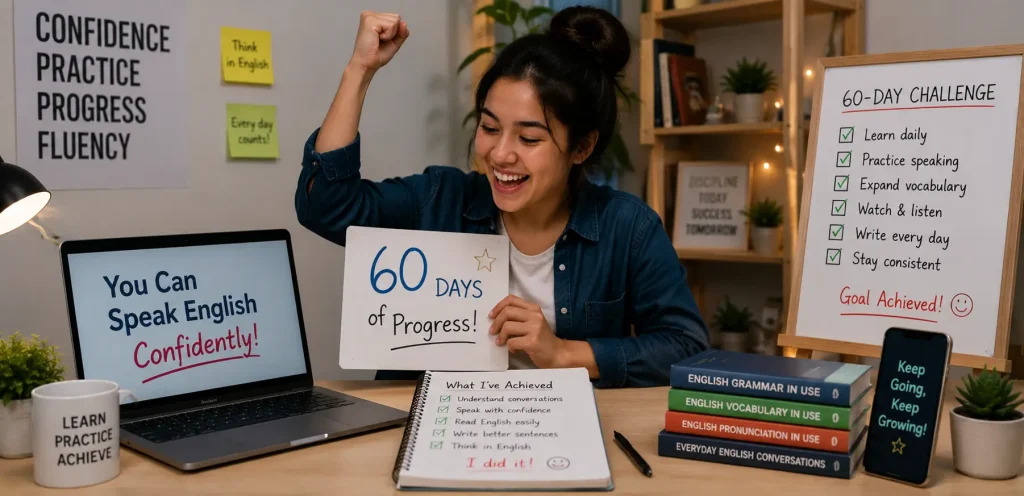
Conclusion:
Sixty days goes faster than you think. You won’t finish it perfect, and you probably won’t finish it exactly on schedule either. That’s fine. What matters is that you’re further along than you were when you started, and you actually used the language along the way not just studied it.
Pick a start date. Write it down. Then just begin at Col’s calibre